
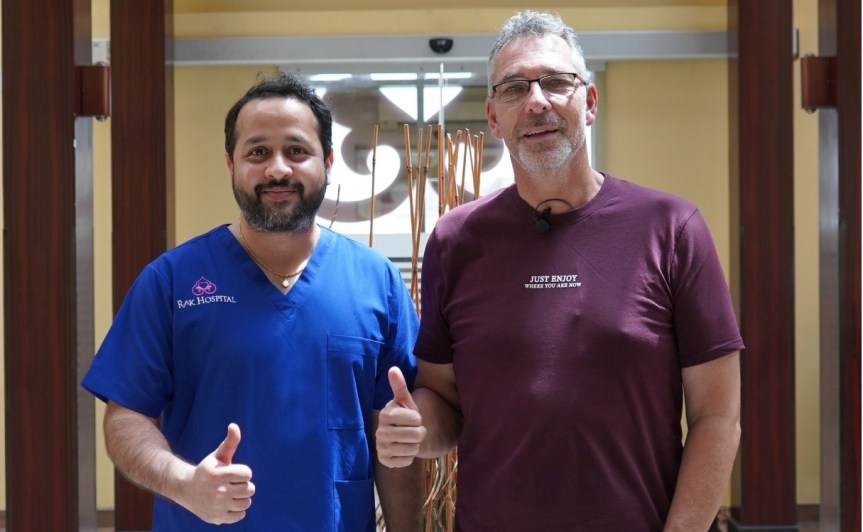
This lack of awareness often results in delayed diagnosis and prolonged suffering. When pain affects daily activities, see medical guidance immediately, says RAK Hospital expert
12 May 2026, Ras Al Khaimah, UAE –For nearly 30 years, a 59-year-old South African national, Keith Lukin, lived with progressive shoulder arthritis that gradually reduced his mobility to just 10%. Over time, even the simplest daily activities—lifting a cup, reaching overhead, driving, or dressing—became difficult.
Over the years, he sought medical help across multiple centers internationally, undergoing countless physiotherapy sessions and repeated intra-articular steroid injections. Despite these interventions, the condition continued to deteriorate, with no lasting relief.
It was only when he arrived at RAK Hospital that a clear diagnosis was finally made. Under the care of Dr. Bharath Patil, Orthopedic Surgeon, advanced imaging including MRI and CT scans revealed severe degeneration of the shoulder joint, with complete loss of cartilage resulting in a “bone-on-bone” condition, which severely restricted his daily movement and ability to perform simple tasks.
Following a comprehensive evaluation, Dr. Patil recommended a bilateral anatomical total shoulder arthroplasty—a complex joint replacement procedure in which the damaged shoulder joint is replaced with an artificial implant designed to closely replicate the natural anatomy of the shoulder. The goal of the procedure is to relieve pain while restoring smooth, near-normal shoulder movement and function.
The surgery was planned in two stages, beginning with the dominant shoulder, followed by the second after successful recovery and rehabilitation.
Explaining the case, Dr. Patil said, “In advanced shoulder arthritis, where cartilage is completely worn out, patients often reach a stage where conservative treatments are no longer effective. In this case, the rotator cuff muscles were healthy, which made anatomical shoulder replacement the most suitable option.”
“We chose this approach because it offers superior range of motion and exceptional long-term survival rates compared to other options,” added Dr. Patil. “Furthermore, by preserving the anatomical structure, we ensured that if any revision surgery is required decades into the future, the option for a reverse shoulder replacement remains available.”
Adding further, he said, “Moreover, this case represents an important milestone for the region. We are proud to say that this is a significant medical advancement for the Northern Emirates, with RAK Hospital successfully performing a rare and life-changing procedure locally for the first time. After years of unbearable pain, the patient finally found relief here in the UAE, which reflects our ability to deliver advanced orthopedic care at par with international standards, right at the patient’s doorstep.”
Dr. Patil also highlighted a growing regional trend. “While most cases are seen in the 55–60 age group, we are increasingly diagnosing younger patients due to sedentary lifestyles, reduced physical activity, and obesity-related factors. At the same time, many people continue to normalise pain or delay seeking help due to fear or misconceptions that surgery is the only outcome.”
He added that treatment in orthopedics always follows a structured approach. “We never begin with surgery. Patients are first managed with medication, physiotherapy, and injections. Surgery is only recommended when these options fail or when the disease is already advanced.”
Looking back, the patient admits that years of living with pain had gradually become his normal—until he understood that it did not have to be.
“I have been to many doctors over the years, but the way Dr. Bharath explained everything was completely different,” he said. “He was professional, compassionate, and extremely clear, and for the first time I felt confident that I could actually regain my life. I was truly impressed by his demeanour, his calm approach, and his mannerisms—it gave me a level of reassurance I had never experienced before.”
After the first procedure, his recovery exceeded expectations. The second shoulder was subsequently operated on following successful rehabilitation of the dominant side.
The results have been life-changing. From barely 10% mobility, he has now regained nearly 90% range of motion and continues to improve with physiotherapy.
“I am on cloud nine. It feels like I have new arms,” he said. “What once felt impossible is now part of my everyday life again. I only wish I had known about this option earlier—I could have avoided years of unnecessary suffering. I am deeply grateful to Dr. Bharath and the entire team at RAK Hospital for giving me a new lease of life and helping me realise how much I had been missing all these years. Simple tasks like lifting my arm or taking a cup from a cupboard used to be a struggle; now I can do them effortlessly. I truly wish I had discovered this treatment sooner instead of living with pain for so long.”
While full recovery is still ongoing, the transformation has already restored independence, confidence, and quality of life that had been lost for decades.
Dr. Patil emphasized that cases like this are more common than many realize, largely due to lack of awareness and delayed diagnosis.
“Many people assume shoulder pain is something they must live with,” he said. “But when pain begins to affect daily activities like dressing, lifting the arm, or driving, it is important to seek evaluation. Early diagnosis can significantly improve outcomes.”
He also noted that shoulder replacement surgery, though less commonly discussed than knee or hip replacement, is a highly effective solution for advanced joint degeneration and is increasingly available in the region.
Importantly, he cautioned against normalizing chronic pain. “Pain should never become your normal. Patients deserve to live with dignity, confidence, and mobility. There are solutions available—you just need to seek help.”
For the patient, the message is simple but powerful: “Do not ignore pain. You don’t have to live with it. I thought I had no options left—but I was wrong.”
For more information, please visit: https://rakhospital.com
ENDS
 uaenews4u.com